

The key spins in the ignition and nothing happens
It turns all the way around with none of the usual drag, you feel no click into ACC or RUN, and the starter never engages. That is almost never the battery. The lock cylinder is turning without moving the ignition switch, and this fault sets no diagnostic trouble code.
FL Licensed · GA Registered
Two registered entities
15,000+ jobs completed
Same Day Solutions
Rapid Mobile Dispatch
Arrival in 30 min
NASTF VSP
Vehicle Security Professional
9-sec avg phone answer
ALOA Certified
Pro Certified Technicians
25 technicians on rotation
The thirty second check: are the dash lights still coming on?
If the dashboard lights up the way it always does and the key still spins with no weight to it, you have not lost power, so the battery is not your problem. A dead battery gives you dark or dim dash lights and a key that still turns with its normal resistance and its normal clicks. Lights on plus a weightless key points at the mechanical link between the lock cylinder and the ignition switch.
The cylinder is turning. The switch is not.
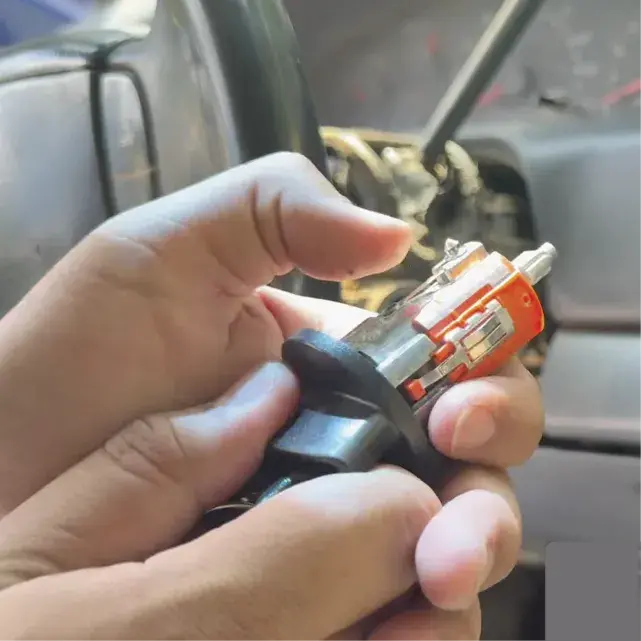
Two parts are involved and almost every page online treats them as one. The ignition lock cylinder is the part your key goes into. The ignition switch is a separate electrical part, mounted behind or below the cylinder on the steering column. The cylinder carries no current at all.
Turning the key rotates the cylinder, and the back of the cylinder, called the cam or the tailpiece, drives the ignition switch through its positions: OFF, ACC, RUN, START. On many vehicles a small shaft called the ignition switch actuator pin sits between the two and does that pushing. The detents you feel, those firm clicks at each position, come from the switch, not from the key.
When that link shears, the cylinder still turns. It turns more freely than it ever did, because it is no longer moving anything. The switch stays in OFF, the starter is never commanded, and you get exactly what you are describing: a key that goes around and around while the car ignores you.
That is the whole diagnosis in one sentence: the key is turning, the switch is not. Everything below is about telling which of the two mechanical causes you have, and ruling out the three unrelated faults people usually try first.
What breaks when a key spins with no resistance
A person cannot tell these two apart from the driver seat, but the repair is different and so is the price.
A broken actuator pin or a sheared cam
Worn wafer tumblers and a worn key blade
Three things this is not
These are the three conclusions people reach first. Each one has a tell that rules it out in seconds.
It is not a dead battery
It is not a locked steering column
It is not the immobilizer rejecting your key
Five checks to run before you pay anyone
Two of these can end the problem without a service call. We would rather you run them than pay us for a dispatch you did not need.
- 1
Turn the key and watch the dashboard, not the engine
Dash lights normal means you have power and the battery is ruled out. Dash dark or very dim means start with the battery and terminals, because nothing downstream will work until that is fixed.
- 2
Feel for the detents as you turn
Turn slowly and feel for the firm clicks at ACC and RUN. Those come from the ignition switch. If they are gone and the key sweeps through with no steps at all, the cylinder is no longer driving the switch. That is the mechanical failure.
- 3
Rock the steering wheel while you turn the key
Do this one even though it can cost us the job. If the key will not turn rather than spinning freely, the steering column lock is loaded. Rock the wheel left and right with light steady pressure on the key and it releases. That fix is free and it needs no locksmith.
- 4
Try the spare key
If the spare works and the everyday key does not, you have wear, not a break. Stop using the worn key immediately, because every turn from here removes more metal from the wafers and turns a cylinder rekey into a cylinder replacement.
- 5
Look at the security light before you call anyone
If the engine cranks or the security light is lit, tell whoever you call. That routes the job to key programming instead of ignition work, and the two are not priced the same. Saying it on the phone is what gets the right van and the right parts sent.
No scan tool is going to find this, and that is not a cover story
A purely mechanical lock cylinder or actuator pin failure sets no diagnostic trouble code. An OBD-II scan reads what the modules report, and no module on your vehicle is watching a sheared pin inside the steering column. A clean scan does not mean nothing is wrong, it means the fault is mechanical. If a shop tells you the scan found your ignition, ask which code and what it means. P0513 is a real code, but it means the immobilizer rejected the key, which is a different repair.
Vehicles we have done ignition work on
Every model and year span below comes from our own job records, not from a brand wish list. Free spin is a domestic and Asian daily driver problem far more often than a luxury one.
| Model | Years | Key Type | What We Do |
|---|---|---|---|
| Chevrolet Silverado | 1999-2023 | Transponder blade key, proximity fob on the newest years | Ignition cylinder replacement, key cut to code, programming on site |
| Chevrolet Equinox | 2006-2013 | Transponder blade key | Ignition cylinder replacement, key cut to code, programming on site |
| GMC Sierra | 2004-2008 | Transponder blade key | Ignition cylinder replacement, key cut to code, programming on site |
| Ford F-150 | 1990-2019 | Metal blade on the early years, transponder blade and fob later | Ignition repair or replacement, key cut to code, programming on site |
| Ford Fusion | 2007-2015 | Transponder blade key | Ignition repair or replacement, key cut to code, programming on site |
| Ford Transit | 2015-2024 | Transponder blade key or proximity fob | Commercial van ignition work, key cut to code, programming on site |
| Honda Civic | 2006-2015 | Transponder blade key | Ignition cylinder replacement, key cut to code, programming on site |
| Honda Accord | 2000-2015 | Transponder blade key | Ignition cylinder replacement, key cut to code, programming on site |
| Honda CR-V | 2003-2021 | Transponder blade key, proximity fob on later years | Ignition cylinder replacement, key cut to code, programming on site |
| Honda Odyssey | 2003-2009 | Transponder blade key | Ignition cylinder replacement, key cut to code, programming on site |
| Toyota Corolla | 1996-2018 | Metal blade on the early years, transponder blade later | Ignition repair or replacement, key cut to code, programming on site |
| Toyota Camry | 2003-2009 | Transponder blade key | Ignition repair or replacement, key cut to code, programming on site |
| Toyota Tacoma | 2013-2022 | Transponder blade key or proximity fob | Ignition repair or replacement, key cut to code, programming on site |
| Nissan Rogue | 2012-2017 | Transponder blade key or proximity fob | Ignition repair or replacement, key cut to code, programming on site |
| Nissan Sentra | 2010-2015 | Transponder blade key | Ignition repair or replacement, key cut to code, programming on site |
| Hyundai Sonata | 2003-2018 | Transponder or proximity key on the equipped trims, plain blade with no chip on the turn-key trims built without an immobilizer, confirmed against the VIN | Ignition repair or replacement, key cut to code, programming on site |
| Kia Sportage | 2015-2020 | Transponder or proximity key on the equipped trims, plain blade with no chip on the turn-key trims built without an immobilizer, confirmed against the VIN | Ignition repair or replacement, key cut to code, programming on site |
| Kia Soul | 2014-2016 | Transponder or proximity key on the equipped trims, plain blade with no chip on the turn-key trims built without an immobilizer, confirmed against the VIN | Ignition repair or replacement, key cut to code, programming on site |
| Volkswagen Jetta | 2005-2017 | Transponder blade key, flip key on later years | Ignition repair or replacement, key cut to code, programming on site |
| Volkswagen Passat | 2012-2016 | Transponder flip key | Ignition repair or replacement, key cut to code, programming on site |
| Dodge Ram | 1996-2018 | Metal blade on the early years, transponder key later | Ignition repair or replacement, key cut to code, programming on site |
| Chrysler 300 | 2005 | Transponder blade key | Ignition repair or replacement, key cut to code, programming on site |
| Mercedes E350 | 2006-2014 | Mercedes SmartKey | Ignition and Electronic Steering Lock (ESL) diagnosis, key programming under NASTF VSP |
Vehicle not listed? It is still worth a call: the column hardware repeats across platforms. See the automotive service hub.
What the fix actually is, and what we ask you for
The repair is a lock job, not an engine job, which is why a locksmith and not a tow truck is the right first call. The column shroud comes off, the lock cylinder comes out, and the broken link or the worn cylinder is replaced. On many General Motors platforms the replacement arrives as an uncoded cylinder, sometimes called a code yourself cylinder, which means the wafers and springs get assembled to your vehicle code on the spot. Strattec is the original lock supplier on most General Motors and Chrysler platforms, so the replacement hardware matches what came out.
If your key is worn, the new key is cut to code, taken from the vehicle rather than copied from the old key. If no key exists at all, the existing lock is decoded with a Lishi two in one pick and decoder before anything is cut. Where the new cylinder can be keyed to your current key, it is, so you keep one key for the doors and the ignition instead of walking away with two.
Wherever the car is parked is where this gets done. The vehicle cannot be driven with a switch stuck in OFF, so the alternative is a tow plus dealer labour plus days without the car. The on site repair skips all three.
Commercial vans and trucks are part of this work, not an exception to it. Ignition jobs on the Ford Transit are in our own records, and our call logs include a Freightliner Sprinter 2500 and a GMC Savana. If the vehicle is a work van, say so when you call, because the column hardware and the key type differ from a passenger car.
One thing we will ask for before we touch the ignition: proof that the vehicle is yours. A title, a registration or an insurance card in your name, plus a photo ID that matches it. A locksmith who does not ask for that is the warning sign, because the same skills that open your car open the next one too.
What this costs, published
Night and weekend rates apply between 9 PM and 7 AM local time, and on Sundays and federal holidays. The exact total is quoted on the phone before a technician is dispatched.
| Service | Day Rate | Night / Weekend |
|---|---|---|
| Ignition repair / replacementFloor price. The total depends on the make, model and year | From $200 | +$75 night |
| Broken-key extraction | $100 - $250 | +$120 night |
| Car key programming (domestic transponder)Toyota, Honda, Ford, Chevy, Nissan, Hyundai, Kia | $150 - $250 | +$50 night |
| All-keys-lost programmingFull new system pairing. The spread is the make: a Toyota key and a Ferrari key are not the same job | $200 - $1,000 | Varies by vehicle |
*Prices shown are reference only. Final cost varies based on the complexity of the service, the specific hardware involved, the vehicle make, model and year, and the time of service. We provide an exact phone quote before our technician is dispatched. Automotive prices depend on the make, the model and the year of the vehicle. A key for a Toyota and a key for a Ferrari are not the same job, and the ranges above reflect that spread. The dispatcher confirms the exact total on the phone before a technician is sent.
Related automotive locksmith services
If the diagnosis above pointed somewhere else, these are the pages that cover it.
Car Lockout
Mobile car lockout 15-30 min, no damage
Lost Car Key Replacement
Mobile cut and OEM programming on-site
Car Key Programming
Transponder, smart key, proximity fob pairing
Smart Key & Key Fob
Push-to-start, proximity fobs, 2014+ vehicles
Ignition Repair
Cylinder replacement, Mercedes ESL, BMW EWS
Broken Key Extraction
Snapped key removal without drilling
Car Key Duplication
Spare keys, copies, transponder cloning
Trunk Lockout
Mobile trunk opening 15-30 min
ECU & Module Programming
ECU, BCM, PCM, TCM flashing and coding
Luxury Key Programming
Mercedes, BMW, Range Rover, Audi, Porsche, Bentley
FAQ - Key Spins in the Ignition
These are the questions people actually ask when the key turns and the car does nothing. If yours is not here, call and describe what the key feels like.
If your symptom is not this one
Each of these is a different fault with a different fix. Pick the one that matches what your key and your car are actually doing.
The key will not turn at all
The opposite symptom. Usually the steering column lock, and usually free to clear yourself.
The key broke off in the ignition
Part of the blade is still inside the cylinder. Removal first, repair second.
The key fob stopped working
Buttons do nothing, or the car ignores the fob. Battery, pairing or a failed remote.
Every key is lost
No working key exists at all, so the new one is cut to code and paired from scratch.
Ignition repair and cylinder replacement
The service page for the repair described above, including Mercedes ESL and BMW EWS work.
Automotive locksmith prices
Every published automotive price in one place, day rates and night rates.
Key spinning? We fix it where it is parked.
Tell the dispatcher what the key feels like and whether the dash lights come on. That one detail decides which technician and which parts get sent.