

Your key goes in but will not turn
The key seats all the way and then stops dead. Two of the four common causes are free and take under a minute: a steering column lock loaded under wheel tension, and a shifter that is not fully seated in Park. Work through those before you pay anybody, including us. If the key still will not rotate, the fault is in the key bitting or in the ignition lock cylinder, and both are fixed where the car is parked.
FL Licensed · GA Registered
Two registered entities
15,000+ jobs completed
Same Day Solutions
Rapid Mobile Dispatch
Arrival in 30 min
NASTF VSP
Vehicle Security Professional
9-sec avg phone answer
ALOA Certified
Pro Certified Technicians
25 technicians on rotation
First: is your key blocked or spinning?
A key that will not rotate and a key that spins freely feel similar in your hand and are opposite failures. If the key is locked solid and the plug will not move, you are on the right page: that is a mechanical block, and the four causes below cover almost all of it. If the key rotates normally but nothing happens, the lock cylinder is doing its job and the fault sits behind it, in the ignition switch, the immobilizer or the starting circuit. Read the right one, because the repairs share no parts.
Four checks, and two of them are free
Work these in order. Two of the four common causes cost nothing and take under a minute, and we would rather you fix it yourself than pay us for a drive-out.
- 1
Stop pulling on the key
Force is what turns a twenty-second fix into a broken-key extraction. A key blade snaps at the shoulder under far less torque than people expect, and a snapped blade inside the plug is a separate job. Take the load off the key before you do anything else.
- 2
Unload the steering column lock
When you pull the key, a spring-loaded lock pin drops into a slot in the steering shaft. If you parked with the wheel turned, or the front tires are pressed against a curb, the weight of the car holds that pin hard against the slot and the plug physically cannot rotate. Put light, steady turning pressure on the key, about what you would use on a house key, and rock the wheel gently left and right with your other hand. The key turns by itself the instant the pin is free.
- 3
Seat the shifter fully in Park
On an automatic, the shift interlock (BTSI, Brake Transmission Shift Interlock) ties the ignition to the shifter position. A shifter that looks like it is in Park but is one notch short, or a worn park position switch, will hold the key. Push the lever firmly into Park. If that changes nothing, hold the brake, move it to Neutral, and try the key there.
- 4
Try the spare key
This is the test that decides the whole diagnosis, and it costs nothing. If the spare turns and your everyday key does not, the everyday key is worn: the cuts have lost depth and no longer lift the wafers to the shear line. If both keys fail the same way, the key is not the problem and the fault is in the cylinder or the column.
Two different parts, and almost nobody separates them
The ignition lock cylinder and the ignition switch are two different parts, and almost every page written about this symptom treats them as one. The lock cylinder is the mechanical assembly your key enters. The ignition switch is the electrical unit mounted behind or below it, usually driven by a rod or a cam gear, and it carries the ACC, ON and START circuits. A key that will not rotate is a lock cylinder or steering column problem. A key that rotates freely and produces nothing is an ignition switch or immobilizer problem. Same hole, different parts, different repair.
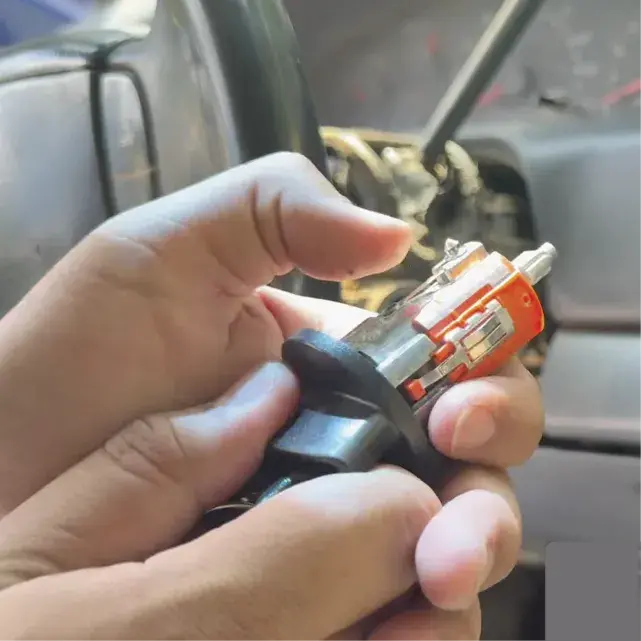
Automotive ignitions are wafer locks, not pin-tumbler locks. Inside the plug are flat, spring-loaded wafers that must be lifted to exactly the shear line by the cuts on your key before the plug can turn. That matters because it explains the two ways this fails mechanically: the wafers wear and stop seating cleanly, or the key wears and stops lifting them far enough. A page that talks about pins in a car ignition was not written by anyone who has had a steering column apart.
A worn key is the cause people most often get wrong, because the key looks fine. Bitting wears a few thousandths at a time over years in a pocket, and the failure is gradual until the day it is total. The correct fix is a key cut to code from the VIN, or cut from depths decoded directly off the lock. The wrong fix, and the one a kiosk will happily sell you, is a copy of the worn key: a copy reproduces the worn cuts and fails exactly the same way, usually within weeks. Read how cutting to code differs from duplicating a key.
There is no trouble code for a key that will not turn
A key that will not rotate is a mechanical failure, and it sets no diagnostic trouble code. The engine control module was never asked to do anything, because the ignition never reached START. No scan tool will read a code for this, because there is no code to read. If a shop quotes you a diagnostic code for a key that will not turn, they are either describing a different symptom or selling you one.
What a failing cylinder feels like
If you recognise more than one of these, the cylinder has been telling you for a while. They do not reverse on their own.
Key stops dead at zero degrees
Key sticks part way around
You have to jiggle it every time
The key falls out while the engine runs
The cylinder feels loose or wobbly
The wheel will not release even with the key out
Four things people get quoted for by mistake
A key that will not rotate rules several expensive repairs out before anyone opens a toolbox. Knowing which ones protects you on the phone.
It is not the immobilizer
It is not a dead battery
P0513 is a different symptom
It is not module programming
What this looks like on the cars we actually work on
These are the makes, models and year spans behind our own ignition work, not a list of prestige badges. The mechanism is not the same on all of them, and that changes what you should try first.
| Model | Years | Key Type | What We Do |
|---|---|---|---|
| Honda Accord | 1998-2019 | HON66 wafer cylinder | Mechanical column lock. Free the wheel first. If both keys fail, the cylinder comes out on site. |
| Honda Civic | 2010-2022 | HON66 wafer cylinder | Same column lock behaviour as the Accord. Worn-key failures are common at this age. |
| Honda CR-V | 2003-2014 | HON66 wafer cylinder | High-mileage wafer wear. Key cut to code, or cylinder replaced and re-keyed to the existing key. |
| Toyota Corolla | 1999-2018 | TOY43 wafer cylinder | Column lock plus a wafer stack that wears predictably. Decoded and cut on site. |
| Toyota Camry | 2008-2020 | TOY43 wafer cylinder | Later trims are push-to-start, where the symptom is a wheel that will not release, not a key that will not turn. |
| Chevrolet Silverado | 2015-2023 | B111 / B106 keyway | Column lock plus cylinder. Truck weight on a turned wheel loads the lock pin hard, so rock the wheel properly before calling. |
| Chevrolet Malibu | 1999-2017 | B111 / B106 keyway | Older GM cylinders and sidebar-era hardware. Cylinder replaced and keyed on site. |
| Ford F-150 | 2012-2020 | Blank decoded on site | Ford changed blade profile inside this span, so we decode the lock rather than publish one code for all of it. Worn blades fail to lift the wafers long before the key looks worn. |
| Ford Explorer | 2009-2020 | Blank decoded on site | Ford changed blade profile inside this span, so we decode the lock rather than publish one code for all of it. Cut to code from the VIN with proof of ownership. |
| Volkswagen Jetta | 2007-2020 | HU66 keyway | Column lock plus a cylinder that binds as it wears. Cut to code, cylinder swapped if it is the plug. |
| Hyundai Sonata | 2008-2017 | Blank decoded on site | We decode the lock rather than publish a blank code we have not verified. Cylinder or key, diagnosed in the driveway. |
| Nissan Rogue | 2011-2023 | Blank decoded on site | Steering lock is commanded by the BCM through an actuator, not a plain mechanical pin. Rocking the wheel will not free it if the actuator is the fault. |
| Nissan Altima | 2014-2021 | Blank decoded on site | Same actuator-based steering lock. We confirm whether the block is mechanical or commanded before touching the column. |
| Mercedes-Benz C300 | 2010-2022 | HU64 keyway | W204 and W205 use an Electronic Steering Lock (ESL, also ELV). There is no pin to rock free. Module-level work, coded to the car, NASTF VSP required. |
| BMW 535i | 2010-2017 | Blank decoded on site | CAS immobilizer family. Column lock behaviour differs from a plain wafer cylinder and is diagnosed as a module, so the blade profile is read off the lock rather than published. |
| RAM 2500 | 2012-2025 | CY24 keyway | Later trucks use a WIN module (Wireless Ignition Node) in place of a conventional cylinder. Different part, different diagnosis. |
Keyway codes are published only where we are confident of them. Where we are not, the row says the blank is decoded on site rather than guessing. Same rule for fault codes: the Nissan steering lock actuator and the Chrysler WIN module both have documented failure patterns, so we describe the mechanism and leave the code numbers off the page.
What the paid fix costs, if you need it
Only relevant once the free checks have failed. Night and weekend rates apply between 9 PM and 7 AM local time, and on Sundays and federal holidays.
| Service | Day Rate | Night / Weekend |
|---|---|---|
| Ignition repair or cylinder replacementWhat the fix costs when the cylinder, not the key, is the fault | From $200 | +$75 night |
| Key cut to code, metal blade with no chipOlder vehicles with no transponder. The correct fix for a worn key | $50 - $100 | +$120 night |
| Key cut and duplicated, transponder or fobCut to code from the VIN when the original is worn, never copied off the worn key | $100 - $250 | +$120 night |
| Key programming, domestic transponderToyota, Honda, Ford, Chevy, Nissan, Hyundai, Kia | $150 - $250 | +$50 night |
| Broken-key extractionWhat forcing a stuck key usually turns into | $100 - $250 | +$120 night |
| All-keys-lost programmingFull new system pairing. The spread is the make: a Toyota key and a Ferrari key are not the same job | $200 - $1,000 | Varies by vehicle |
*Prices shown are reference only. Final cost varies based on the complexity of the service, the specific hardware involved, the vehicle make, model and year, and the time of service. We provide an exact phone quote before our technician is dispatched. Automotive prices depend on the make, the model and the year of the vehicle. A key for a Toyota and a key for a Ferrari are not the same job, and the ranges above reflect that spread. The dispatcher confirms the exact total on the phone before a technician is sent.
What you should expect from whoever you call
We ask for proof of ownership
Work vans and light trucks included
Fixed where the car is parked
The quote is set before dispatch
Related automotive services
Every automotive job has its own page with the process, the price range, and what our van brings to you.
Car Lockout
Mobile car lockout 15-30 min, no damage
Lost Car Key Replacement
Mobile cut and OEM programming on-site
Car Key Programming
Transponder, smart key, proximity fob pairing
Smart Key & Key Fob
Push-to-start, proximity fobs, 2014+ vehicles
Ignition Repair
Cylinder replacement, Mercedes ESL, BMW EWS
Broken Key Extraction
Snapped key removal without drilling
Car Key Duplication
Spare keys, copies, transponder cloning
Trunk Lockout
Mobile trunk opening 15-30 min
ECU & Module Programming
ECU, BCM, PCM, TCM flashing and coding
Luxury Key Programming
Mercedes, BMW, Range Rover, Audi, Porsche, Bentley
FAQ - Key Will Not Turn in the Ignition
Got questions? We have answers. If you don't see your question below, call us anytime - we're available 24/7.
Keep reading
The sibling symptom, the published price guide, and the credential that decides who can legally touch a Mercedes steering lock.
My key spins freely instead
The opposite failure. The cylinder turns with no resistance, the engine does nothing, and the diagnosis moves behind the lock.
Automotive Locksmith Prices
Every published automotive rate, day and night, with what moves each number.
What Is NASTF VSP?
The credential required for Mercedes ESL and BMW module work, and how to verify it.
Checks done and it still will not turn?
Pick your area and the dispatcher confirms the exact total on the phone, after-hours surcharge included, before a technician leaves.