

My key snapped and half of it is stuck in the ignition
Stop turning it. What you do in the next few minutes decides whether this ends as a short extraction or as a new lock cylinder plus an immobilizer relearn. Here is what to check before you pay anyone, what makes it worse, and how to tell whether the half still in your hand can be cut into a working key.
FL Licensed · GA Registered
Two registered entities
15,000+ jobs completed
Same Day Solutions
Rapid Mobile Dispatch
Arrival in 30 min
NASTF VSP
Vehicle Security Professional
9-sec avg phone answer
ALOA Certified
Pro Certified Technicians
25 technicians on rotation
The first 90 seconds: stop, look, and put nothing into the keyway.
Almost every expensive version of this job started as a good-faith attempt to fix it. Glue, spray lubricant and pliers each have their own specific way of turning a short extraction into a cylinder replacement. Read the six steps below before you touch the lock again.
What to do when a car key breaks off in the ignition
Six things, in order. The first five cost nothing and the sixth is what gets you a real number on the phone.
- 1
Take your hand off the key and stop turning
The fragment is already wedged against the wafers. More torque does not free it, it chips wafer edges, and a sheared wafer is the whole difference between an extraction and a new cylinder.
- 2
Look at where the break sits
Protruding past the face of the plug, flush with it, or recessed inside the keyway. That single observation decides everything that follows, and it is the first thing a dispatcher will ask you.
- 3
Keep the half you are holding, and keep it clean
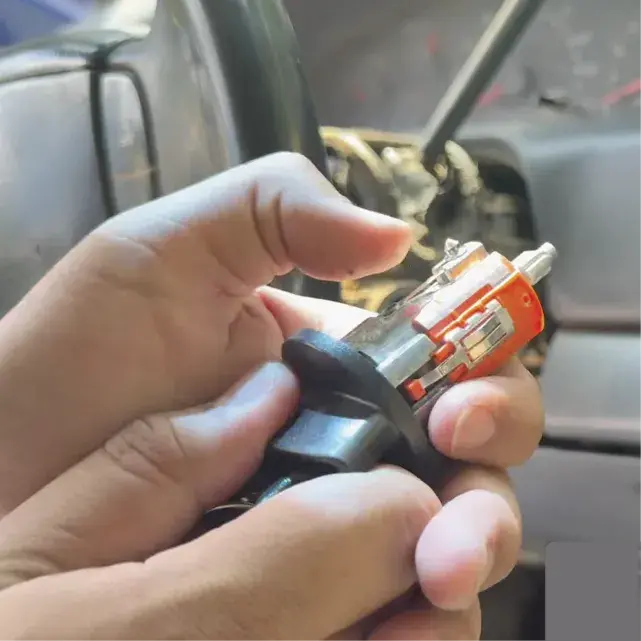
The bow, meaning the plastic head, carries the transponder chip. The blade stub carries part of the cut pattern and often the shoulder that a duplicator clamps against. Do not file it, do not glue it, do not toss it in the glove box.
- 4
Put nothing into the keyway
No super glue, no WD-40, no penetrating oil, no paperclip, no jigsaw blade, and no tweezers on a fragment that sits flush. Each of those has its own failure mode, listed in the next section.
- 5
One straight pull is reasonable, but only if the fragment protrudes
If you can grip metal standing proud of the plug face, needle nose pliers pulling straight out, with zero twisting, can work. If the fragment is flush or recessed, stop. Pliers there only push it deeper past the wafers.
- 6
Photograph the keyway and the half in your hand before you call
Two photos tell a dispatcher whether this is an extraction, an extraction plus a cut, or an extraction plus programming. That is how you get a real number on the phone instead of a shrug.
Will super glue, WD-40 or pliers get a broken key out?
Three internet fixes, three specific mechanisms of damage. The honest answer on the pliers is conditional, not a flat no.
Super glue bonds the fragment to the lock
WD-40 is a water displacer, not a lock lubricant
Pliers and tweezers only work on a fragment that protrudes
Turning the plug with the fragment inside shears wafers
Can a broken key be removed from an ignition without damaging the lock cylinder?
Usually yes, and the method is unglamorous. A thin extractor goes down the keyway alongside the blade, hooks a cut or the tip of the fragment, and draws it straight out while the wafers sit at rest. The plug is never rotated and nothing is drilled. Three tool shapes cover most of it: a spiral extractor that threads into the gap and bites, a single barbed hook, and a double hook worked from both sides of the keyway.
Two components get confused here, and the difference is money. The ignition lock cylinder is the mechanical part your key goes into. The ignition switch is the electrical part behind it that actually sends power to the starter. A snapped blade is a cylinder problem. It does not damage the switch, and a quote that replaces both because a key broke deserves a second opinion.
Extraction fails in three situations, and two of them are self-inflicted: the fragment was driven past the wafers by an earlier attempt, a wafer was sheared by forced rotation, or the fragment was glued in place. Then the cylinder has to come out, which is a different job at a different price.
If the cylinder does have to come out, that work lives on Ignition Repair, and the hire-us version of the extraction itself is on Broken Key Extraction.
Can a new key be cut from a broken key half?
This is the question that decides the total, and the answer lives in the blade, not in the head of the key. A key is a set of depths cut at fixed spaces, all measured from the shoulder, the small step where the blade meets the bow. A machine can copy that pattern only if it can see the whole of it and clamp against a reference point.
If the blade snapped somewhere out toward the tip, the stub in your hand usually still carries the shoulder and most of the pattern, and the fragment recovered from the lock carries the rest. Put the two together and the full bitting is readable, so a new blade can be cut directly instead of decoded. That is the cheap outcome.
If the blade snapped right at the shoulder, or the stub has been filed, bent or glued, there is no reference point left to clamp against. The fallbacks are decoding the cylinder by reading the wafer depths, or pulling the key code from the VIN. Both work. Both cost more than a copy.
Blade style changes the difficulty. An edge-cut blade, the familiar double-sided car key, can often be read by eye and confirmed with a depth gauge. A laser-cut blade, also called a sidewinder or internal-cut, carries its track milled into the flat of the blade and generally needs a decoding gauge or the code itself.
You do not need both halves in the sense people mean it. What you need is enough of the cut pattern, with a usable shoulder, across whatever pieces exist. The half in the lock comes out during the extraction anyway, so in practice you almost always end up holding both.
The chip is in the head of the key, not in the blade.
On nearly every transponder key the chip sits inside the plastic bow. A clean blade break leaves it electrically intact, which is why a snapped key is usually not an all-keys-lost job: the chip can be cloned onto a new key, or the original head reused with a new blade where the key design allows. Two exceptions worth checking. A bow that is cracked, crushed or was driven over can have a damaged chip or antenna ring. And a chip that still works does not help if that key was never programmed to this car in the first place.
Why do car keys snap off in the ignition?
Brass and nickel silver work-harden. Every insertion, every turn, every flex in a pocket moves the metal a little, and over years the blade loses ductility and turns brittle. The stress concentrates at the shoulder, which is why that is where keys usually go.
The lock is the other half of the story. Wafers and their springs wear, the plug picks up grit, and the torque needed to rotate it climbs a little each year. So the driver supplies more force through a blade that is getting more brittle. Neither side is dramatic on its own, and together they fail on an ordinary Tuesday morning.
Keys used as screwdrivers, box cutters, pry bars and bottle openers get there faster. So do keys carried on a heavy ring, because the weight hanging off the bow works the blade every time you drive.
The warning sign is a key that needs jiggling, or a cylinder that has started to feel sticky or gritty. That is the moment to have a spare cut, while the original still reads cleanly. After it snaps, the copy costs more because the pattern has to be recovered first.
One thing to ignore: there is no diagnostic trouble code for a broken key. A snapped blade is a mechanical failure and it sets nothing in the OBD-II system. If someone tells you a scan tool found it, that is not how any of this works.
Key broke in the car door lock instead of the ignition
Same symptom, two different jobs. Extraction difficulty, part cost and whether the car still moves all change with the lock.
Ignition lock cylinder
Door, trunk, hatch and glove box cylinders
Key snapped in the ignition. Can I still drive the car?
If the engine is already running when the blade snaps, it keeps running. Accessories shut down on key-out detection on modern vehicles, but a running engine does not stop because a piece of metal broke. Drive somewhere safe and park. Do not try to cross town on it, because once it is off it will not restart while the keyway is blocked.
If the car is off, treat it as stationary. The steering column lock can already be engaged, and a fragment sitting in the keyway blocks a spare key from going in. Forcing the spare in on top of the fragment drives it deeper, which is the same escalation as the pliers.
Do not reach for a tow on reflex. A tow to a dealership is a real cost stacked on top of the real repair, and extraction is a mobile job by nature. The exception is a vehicle parked somewhere genuinely unsafe.
If the car is somewhere you cannot leave it, our car lockout and emergency dispatch run around the clock in both states.
Does a broken key in the ignition mean the cylinder has to be replaced?
Four rungs. Which one you land on is decided by the state of the fragment, and by what was tried before we arrived.
- 1
Extraction only
The fragment comes out, the plug rotates normally, and the key still in your hand carries enough of the pattern to keep using or to copy. Nothing else is touched and nothing else is billed.
- 2
Extraction plus a key cut
Same as above, except the remaining half is not usable as a key. The pattern is read across the recovered pieces and a new blade is cut on site.
- 3
Extraction, cut, and programming
The vehicle uses a transponder or a proximity system, so the new key also has to be paired to the immobilizer. This is where the make, the model and the year start to matter, and why there is no single flat price.
- 4
Cylinder replacement, then an immobilizer relearn
A sheared wafer, a glued plug, or a fragment driven so deep it cannot be hooked. The cylinder comes out, a new one goes in, and keys are relearned so the key that turns the new lock also starts the engine. This is the rung the DIY attempts push you onto.
What each rung actually costs
Day and night rates, published rather than quoted on arrival. The night rate applies between 9 PM and 7 AM local time, and on Sundays and federal holidays.
| Service | Day Rate | Night / Weekend |
|---|---|---|
| Broken-key extraction | $100 - $250 | +$120 night |
| Key cutting, metal blade (no chip)Older vehicles with no transponder in the key | $50 - $100 | +$120 night |
| Car key duplication (transponder or fob)Copy made from a key that still works | $100 - $250 | +$120 night |
| Car key programming (domestic transponder)Toyota, Honda, Ford, Chevy, Nissan, Hyundai, Kia | $150 - $250 | +$50 night |
| All-keys-lost programmingFull new system pairing. The spread is the make: a Toyota key and a Ferrari key are not the same job | $200 - $1,000 | Varies by vehicle |
| Ignition repair / replacementFloor price. The total depends on the make, model and year | From $200 | +$75 night |
*Prices shown are reference only. Final cost varies based on the complexity of the service, the specific hardware involved, the vehicle make, model and year, and the time of service. We provide an exact phone quote before our technician is dispatched. Automotive prices depend on the make, the model and the year of the vehicle. A key for a Toyota and a key for a Ferrari are not the same job, and the ranges above reflect that spread. The dispatcher confirms the exact total on the phone before a technician is sent.
Getting a replacement car key from the VIN when the old key is broken
When the fragment cannot be read and the cylinder cannot be decoded, the last route is the key code held by the manufacturer. It is retrieved from the VIN through the National Automotive Service Task Force, under the Secure Data Release Model, by a technician holding an active Vehicle Security Professional ID. 4Keys holds that credential.
Proof of ownership is required before any of that happens, and we require it as policy, not only because the portal does. Accepted: the title, a current registration, or an insurance card, in the caller name, together with a photo ID that matches it. If the vehicle is in a company name, a letter on company letterhead plus ID for the person signing.
A locksmith who does not ask for proof of ownership on a no-working-key job is the warning sign. It is the cheapest check available on whether the person in front of you is legitimate, and the ones who skip it are skipping it for a reason.
The credential itself is explained on NASTF VSP, and the 60 second version of how to check any locksmith is in How to Verify a Locksmith.
Broken key stuck in the ignition of a 2010 Chevrolet Equinox
That exact line came off our own call log, and it is a useful example precisely because it is an ordinary vehicle rather than an exotic. The make, the model and the year change three things: the blade style, whether the key carries a transponder, and what has to happen after the new key is cut.
Vehicles we cut and program keys for routinely include the Honda Accord (1998 to 2019), Honda Civic (2010 to 2022), Honda CR-V (2003 to 2014), Toyota Corolla (1999 to 2018), Toyota Camry (2008 to 2020), Toyota RAV4 (2009 to 2016), Toyota 4Runner (2001 to 2022), Chevrolet Silverado (2015 to 2023), Chevrolet Malibu (1999 to 2017), Chevrolet Cruze (2014 to 2015), Chevrolet Equinox, Hyundai Sonata (2008 to 2017), Nissan Altima (2014 to 2021), Nissan Sentra (2010 to 2025), Nissan Rogue (2011 to 2023), Ford F-150 (2012 to 2020), Ford Explorer (2009 to 2020), Ford Fusion (2007 to 2015), Volkswagen Jetta (2007 to 2020) and Volkswagen Atlas (2024 to 2025).
Work vans and trucks are on the same list, and most locksmith sites stay quiet about them. We have cut and programmed keys for a Freightliner Sprinter 2500 and a GMC Savana, plus the RAM 2500 (2012 to 2025) and the Ford Ranger (2021 to 2023). A van key lives in a pocket and goes in and out of the cylinder all day, which is exactly the duty cycle that work-hardens a blade.
European and luxury sit in the same shop: Mercedes C300 (2010 to 2022), Mercedes E350 (2014 to 2021), BMW 535i (2010 to 2017), BMW M4 (2016 to 2023), Lexus RX350 (2013 to 2024), Land Rover Discovery (2008 to 2025), Acura TL and TLX. The extraction is the same physics. The programming afterward is not, which is the entire reason the published price is a range rather than a number.
We do not guess the blade. The dispatcher takes the year, the make and the model, and the technician confirms against the VIN before anything is cut.
Every automotive job has its own page
The process, the published range, and what the van brings. One page per job, including the transactional version of this extraction.
Car Lockout
Mobile car lockout 15-30 min, no damage
Lost Car Key Replacement
Mobile cut and OEM programming on-site
Car Key Programming
Transponder, smart key, proximity fob pairing
Smart Key & Key Fob
Push-to-start, proximity fobs, 2014+ vehicles
Ignition Repair
Cylinder replacement, Mercedes ESL, BMW EWS
Broken Key Extraction
Snapped key removal without drilling
Car Key Duplication
Spare keys, copies, transponder cloning
Trunk Lockout
Mobile trunk opening 15-30 min
ECU & Module Programming
ECU, BCM, PCM, TCM flashing and coding
Luxury Key Programming
Mercedes, BMW, Range Rover, Audi, Porsche, Bentley
¿Se te partió la llave dentro del switch?Esta página también está en español
La versión en español de esta página tiene lo mismo: qué hacer en los primeros minutos, qué no meter en la bocallave, y si la mitad que te quedó en la mano sirve para cortar una llave nueva. Atendemos en español sin recargo por idioma.
FAQ - Broken Key in the Ignition: Real Questions
Phrased the way people actually describe the problem when they call. Prices come from our published table.
Keep Reading
Where the numbers come from, how to check a locksmith before you hand over a key, and what the dealer route costs instead.
Automotive Locksmith Prices
Automotive price list with day and night rates
Locksmith vs Dealer Car Keys
Cost, time and warranty comparison
How much does a locksmith cost in Miami
Miami locksmith pricing breakdown
Half the key is in the lock. Do not glue it.
Tell the dispatcher where the break sits and what the vehicle is, and you get the number before a van leaves.