

I lost the only key to my car. There is no spare.
The trade calls this all keys lost, and it is not a copy. With no key to read, there is nothing to clone: the immobilizer has to be taught a credential it has never seen, the blade has to be cut from the factory code instead of traced from an original, and every key programmed before today should be erased. Here is what that involves, what we need from you, and what to check before you pay anyone.
FL Licensed · GA Registered
Two registered entities
15,000+ jobs completed
Same Day Solutions
Rapid Mobile Dispatch
Arrival in 30 min
NASTF VSP
Vehicle Security Professional
9-sec avg phone answer
ALOA Certified
Pro Certified Technicians
25 technicians on rotation
All keys lost (AKL) is the trade term for exactly what happened to you
It means no working key to the vehicle exists anywhere: not a spare, not a valet key, not a worn one that still turns. The distinction is not paperwork, it decides the method. With one working key the job is a duplication, done by reading the key you already hold. With zero keys, the vehicle security system has to be brought to accept a credential it has never seen, which is a different procedure, a different authorization and a different price.
Before you pay anyone, check these five things
Every one of these costs us a dispatch when it works out. Check them anyway.
- 1
Find out whether a second key exists before you call it lost
A second key is often in the folder from the purchase, in a partner's bag, on a keyring at work, or still with the person who sold you the car. If any key still starts the engine, this is a duplication job and not an all-keys-lost job, and it costs a fraction of one. Ten minutes of looking is worth the call.
- 2
Look for the key code tag from the original sale
New vehicles ship with a small metal or plastic tag carrying the factory key code, usually handed over in the sale folder rather than attached to the key. It will not start the car, but it lets a blade be cut by code with no decoding work at all. If you find it, keep it somewhere that is not the vehicle.
- 3
Ask whether something you already pay for covers this
Key replacement is a listed benefit on some auto insurance policies, on some roadside assistance plans, and on manufacturer programs during the warranty period. Check before paying out of pocket, because reimbursement usually depends on the invoice itemising the work a particular way, which is easier to arrange before the job than after it.
- 4
If the vehicle is leased, rented or company-owned, call the titleholder first
A lease or rental company usually holds a second key, and always holds the title. They may also require their own written authorization before anyone cuts a key for that VIN. That authorization is a document we have to ask you for anyway, so starting there saves a trip.
- 5
Write the VIN down before you call anybody
The 17-character VIN is on the driver side dash at the base of the windshield, on the sticker in the driver door jamb, and on your registration and insurance card. The VIN is what replaces the missing key: it is the input for the key code and for the security data, and without it nobody can quote you honestly.
Why this costs a multiple of the copy you made last year
A copy and a new key are not the same operation. Duplication reads the transponder chip inside a key that already works and writes that same identity onto a new chip. The immobilizer is never touched, never told anything and never asked to change its mind: it keeps looking for the identity it already knows, and now finds it in two places.
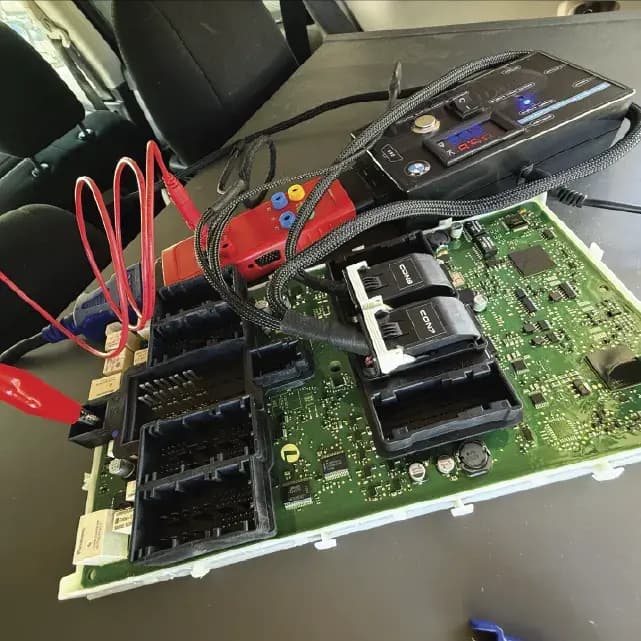
All keys lost is the opposite operation. There is no transponder to read, so nothing can be cloned. The immobilizer has to be brought to accept an identity it has never seen, and a system whose entire purpose is to refuse that does not do it on request. It takes the vehicle's own security data, which on most makes is held by the manufacturer and released against the VIN through an authorized channel rather than read off the car in a parking lot.
The blade changes too. A copy is cut by tracing or decoding a key that exists. With no key, the blade is cut from the factory key code retrieved for that VIN, or decoded from a lock on the vehicle, which on some platforms means removing a door lock or the ignition lock cylinder to read it. Worth separating two parts that get used as synonyms: the ignition lock cylinder is the mechanical plug the blade turns, and the ignition switch is the electrical component behind it. Decoding the cylinder is not a repair of the switch, and replacing the switch does not give you a key.
One more thing that is true and that almost nobody says out loud: there is no diagnostic trouble code that means "the key is lost". A scan tool will not report one, because losing a key is not a fault in the car. Some platforms do log that fewer than the minimum number of keys are currently programmed, which is a different statement about a healthy system. If someone quotes you a fault code for a lost key, ask which module set it.
The published figures follow the same split. A copy made from a key that still works runs $100 to $250. Programming from zero keys runs $200 to $1,000 across the vehicles we cover, and $400 to $900 on luxury European makes. The spread inside those ranges is the vehicle, not the mood of the technician: the make, the model and the year decide which method the platform allows.
If it turns out a working key does exist, the cheaper route is car key duplication, and we will tell you so on the phone rather than after we arrive.
The ignition on-off procedure you found on YouTube needs two working keys
Most of the owner-level key programming procedures published for domestic and Asian makes are on-board procedures: they add a key while two already-programmed keys are present, and those two existing keys are what authorizes the third. With zero keys there is nothing to authorize with, so the procedure never starts. That is not a gap in the video, it is the point of the system. Every route that works from zero keys goes through the vehicle security data instead, which is why it needs an authorized professional and why it is not a driveway job.
Six things that make an all-keys-lost job different from a key cut
The vocabulary below is the job, not marketing. If a quote does not account for these, it is a quote for something else.
Security data released against the VIN
A blade cut by code, not traced from a pattern
A programming path the platform dictates
Every previously programmed key erased
Push-to-start changes the whole job
Work vans and trucks are included
How a key is made when there is no key
Six steps. Two of them are yours, and the job does not start without them.
- 1
You give us the VIN and we confirm what the platform allows
Year, make, model, the 17-character VIN, and whether the vehicle starts with a button or a turned key. We check what that specific vehicle accepts from zero keys before quoting, because the method decides both the price and the time.
- 2
You prove the vehicle is yours
Title, current registration, or insurance in your name, plus a photo ID that matches it. We check this before any work starts, on every all-keys-lost job, with no exceptions and no "we will sort it after".
- 3
We open the vehicle without damage
Non-destructive entry so the cabin and the OBD-II connector are reachable. On a push-to-start vehicle the door may open with the emergency blade once that blade is cut, using the keyhole under the cap on the handle.
- 4
The blade is cut by code
Cut from the factory key code for your VIN, or from a lock decoded on the vehicle, on the blade profile that VIN calls for. Cut on site, in the van, not ordered and waited for.
- 5
Security data is requested and the key is learned
The vehicle security data is requested against the VIN through the authorized channel, then the new key is learned to the immobilizer by the path that platform allows. Some platforms impose their own timed security wait before they will accept a new credential, and no tool shortens it. We tell you on the phone if yours is one of them.
- 6
Previous keys are erased and the result is verified
Keys programmed before today are erased so they no longer start the vehicle. We then test start, lock, unlock, panic and, where fitted, remote start, and leave the paperwork with you so the job is documented against the VIN.
What we have to see before we cut anything
A locksmith who will make a key from scratch without asking for any of this is the warning sign, not the bargain. Making a working key for a car is making a working key for a car, whoever is standing next to it.
The title, or the current registration
Or insurance in the caller's name
Photo ID that matches the document
Written authorization for leased, rented or company vehicles
What to have in front of you when you call
Six things, and the quote stops being a guess: the 17-character VIN, the year, the make and the model, whether the car starts with a button or a turned key, where the vehicle is actually parked, and the ownership document with your ID. The VIN is the one that matters most, because it is what replaces the missing key. If you have the key code tag from the original sale, mention it, because it removes a whole step.
Do I have to tow it to the dealer?
No, and the tow is the part nobody prices in. A dealership works on vehicles at the dealership, so a car that cannot be started has to arrive on a flatbed, and it leaves the same way if the key is not finished that day.
The dealer route is a sequence of queues: the vehicle is towed in, a key is ordered against the VIN because the correct blank and blade profile are rarely on the shelf, the parts department waits for it, and the service department programs it when a bay and a technician are free. The proof of ownership you would show us is required there too. None of that is the dealer being difficult, it is what happens when the car has to come to the tools.
A mobile all-keys-lost job removes the transport and the parts queue by bringing the blanks, the cutting machine and the programming tools to the vehicle. It does not remove the two things that belong to the car rather than to the provider: the authorization step, and any timed security wait the platform imposes. Anyone who tells you those two disappear is selling you something other than a legitimate key.
We put the two routes side by side in locksmith vs dealer for car keys, including what each one does with the car itself.
Vehicles we have made keys for with no key present
Taken from our own service records, with the year spans we actually worked on. Ordered by make, not by how often we see them.
| Model | Years | Key Type | What We Do |
|---|---|---|---|
| Acura TL | 2004 - 2009 | Blade transponder key | All keys lost: key code by VIN, blade cut by code, key learned to the immobilizer, previous keys erased |
| BMW 535i | 2010 - 2017 | Proximity smart key on most trims | All keys lost: key code by VIN, blade cut by code, key learned to the immobilizer, previous keys erased |
| BMW M4 | 2016 - 2023 | Proximity smart key on most trims | All keys lost: key code by VIN, blade cut by code, key learned to the immobilizer, previous keys erased |
| Chevrolet Cruze | 2014 - 2015 | Blade transponder key | All keys lost: key code by VIN, blade cut by code, key learned to the immobilizer, previous keys erased |
| Chevrolet Equinox | 2010 | Blade transponder key | All keys lost: key code by VIN, blade cut by code, key learned to the immobilizer, previous keys erased |
| Chevrolet Malibu | 1999 - 2017 | Blade transponder or proximity smart key, by trim | All keys lost: key code by VIN, blade cut by code, key learned to the immobilizer, previous keys erased |
| Chevrolet Silverado | 2015 - 2023 | Blade transponder or proximity smart key, by trim | All keys lost on a work vehicle: key code by VIN, blade cut by code, key learned to the immobilizer, previous keys erased |
| Ford Explorer | 2009 - 2020 | Blade transponder or proximity smart key, by trim | All keys lost: key code by VIN, blade cut by code, key learned to the immobilizer, previous keys erased |
| Ford F-150 | 2012 - 2020 | Blade transponder or proximity smart key, by trim | All keys lost on a work vehicle: key code by VIN, blade cut by code, key learned to the immobilizer, previous keys erased |
| Ford Fusion | 2007 - 2015 | Blade transponder or proximity smart key, by trim | All keys lost: key code by VIN, blade cut by code, key learned to the immobilizer, previous keys erased |
| Ford Ranger | 2021 - 2023 | Proximity smart key on most trims | All keys lost on a work vehicle: key code by VIN, blade cut by code, key learned to the immobilizer, previous keys erased |
| Freightliner / Mercedes-Benz Sprinter 2500 | 2016 | Blade transponder key, badge does not decide the system | All keys lost on a work vehicle: key code by VIN, blade cut by code, key learned to the immobilizer, previous keys erased |
| Honda Accord | 1998 - 2019 | Blade transponder or proximity smart key, by trim | All keys lost: key code by VIN, blade cut by code, key learned to the immobilizer, previous keys erased |
| Honda Civic | 2010 - 2022 | Blade transponder or proximity smart key, by trim | All keys lost: key code by VIN, blade cut by code, key learned to the immobilizer, previous keys erased |
| Honda CR-V | 2003 - 2014 | Blade transponder key | All keys lost: key code by VIN, blade cut by code, key learned to the immobilizer, previous keys erased |
| Hyundai Sonata | 2008 - 2017 | Blade transponder or proximity smart key, by trim | All keys lost: key code by VIN, blade cut by code, key learned to the immobilizer, previous keys erased |
| Land Rover Discovery | 2008 - 2025 | Proximity smart key on most trims | All keys lost: key code by VIN, blade cut by code, key learned to the immobilizer, previous keys erased |
| Land Rover LR3 | 2008 | Blade transponder key | All keys lost: key code by VIN, blade cut by code, key learned to the immobilizer, previous keys erased |
| Lexus RX350 | 2013 - 2024 | Proximity smart key on most trims | All keys lost: key code by VIN, blade cut by code, key learned to the immobilizer, previous keys erased |
| Mercedes-Benz C-Class, including C300 | 1999 - 2023 | Blade transponder or proximity smart key, by trim | All keys lost: key code by VIN, blade cut by code, key learned to the immobilizer, previous keys erased |
| Mercedes-Benz E350 | 2014 - 2021 | Proximity smart key on most trims | All keys lost: key code by VIN, blade cut by code, key learned to the immobilizer, previous keys erased |
| Nissan Altima | 2014 - 2021 | Blade transponder or proximity smart key, by trim | All keys lost: key code by VIN, blade cut by code, key learned to the immobilizer, previous keys erased |
| Nissan Rogue | 2011 - 2023 | Blade transponder or proximity smart key, by trim | All keys lost: key code by VIN, blade cut by code, key learned to the immobilizer, previous keys erased |
| Nissan Sentra | 2010 - 2025 | Blade transponder or proximity smart key, by trim | All keys lost: key code by VIN, blade cut by code, key learned to the immobilizer, previous keys erased |
| RAM 2500 | 2012 - 2025 | Blade transponder or proximity smart key, by trim | All keys lost on a work vehicle: key code by VIN, blade cut by code, key learned to the immobilizer, previous keys erased |
| Toyota 4Runner | 2001 - 2022 | Blade transponder or proximity smart key, by trim | All keys lost: key code by VIN, blade cut by code, key learned to the immobilizer, previous keys erased |
| Toyota Camry | 2008 - 2020 | Blade transponder or proximity smart key, by trim | All keys lost: key code by VIN, blade cut by code, key learned to the immobilizer, previous keys erased |
| Toyota Corolla | 1999 - 2018 | Blade transponder or proximity smart key, by trim | All keys lost: key code by VIN, blade cut by code, key learned to the immobilizer, previous keys erased |
| Toyota RAV4 | 2009 - 2016 | Blade transponder or proximity smart key, by trim | All keys lost: key code by VIN, blade cut by code, key learned to the immobilizer, previous keys erased |
| Toyota Tacoma | 2015 | Blade transponder key | All keys lost on a work vehicle: key code by VIN, blade cut by code, key learned to the immobilizer, previous keys erased |
| Volkswagen Atlas | 2024 - 2025 | Proximity smart key on most trims | All keys lost: key code by VIN, blade cut by code, key learned to the immobilizer, previous keys erased |
| Volkswagen Jetta | 2007 - 2020 | Blade transponder or proximity smart key, by trim | All keys lost: key code by VIN, blade cut by code, key learned to the immobilizer, previous keys erased |
Key type varies by trim and by build date inside the same model year, so we confirm the exact key, the blade profile and the programming path against your VIN before quoting. The years shown are vehicles we have worked on, not a limit on what we cover. Gasoline and diesel vehicles only.
All-keys-lost pricing, next to the copy it is not
The duplication line is in this table on purpose. It is the comparison that explains every row below it.
| Service | Day Rate | Night / Weekend |
|---|---|---|
| Car key duplication (transponder or fob)Copy made from a key that still works | $100 - $250 | +$120 night |
| Car key programming (domestic transponder)Toyota, Honda, Ford, Chevy, Nissan, Hyundai, Kia | $150 - $250 | +$50 night |
| Smart proximity key programmingPush-to-start fobs on domestic and Asian makes | $250 - $500 | +$50 night |
| Car key programming (luxury European)Mercedes, BMW, Audi, Range Rover, Porsche, when a working key still exists | $250 - $450 | +$50 night |
| Luxury European, all keys lostNo working key exists. OEM data licensed through NASTF VSP | $400 - $900 | +$50 night |
| All-keys-lost programmingFull new system pairing. The spread is the make: a Toyota key and a Ferrari key are not the same job | $200 - $1,000 | Varies by vehicle |
*Prices shown are reference only. Final cost varies based on the complexity of the service, the specific hardware involved, the vehicle make, model and year, and the time of service. We provide an exact phone quote before our technician is dispatched. Automotive prices depend on the make, the model and the year of the vehicle. A key for a Toyota and a key for a Ferrari are not the same job, and the ranges above reflect that spread. The dispatcher confirms the exact total on the phone before a technician is sent.
Every automotive job has its own page
If your situation is not this one, start from the page that matches it. Each one carries the process, the published range and what the van brings.
Car Lockout
Mobile car lockout 15-30 min, no damage
Lost Car Key Replacement
Mobile cut and OEM programming on-site
Car Key Programming
Transponder, smart key, proximity fob pairing
Smart Key & Key Fob
Push-to-start, proximity fobs, 2014+ vehicles
Ignition Repair
Cylinder replacement, Mercedes ESL, BMW EWS
Broken Key Extraction
Snapped key removal without drilling
Car Key Duplication
Spare keys, copies, transponder cloning
Trunk Lockout
Mobile trunk opening 15-30 min
ECU & Module Programming
ECU, BCM, PCM, TCM flashing and coding
Luxury Key Programming
Mercedes, BMW, Range Rover, Audi, Porsche, Bentley
FAQ - All Keys Lost: the questions people actually ask
Got questions? We have answers. If you don't see your question below, call us anytime - we're available 24/7.
Read next
The price table, the authorization chain, and the dealer comparison, each in full.
Automotive Locksmith Prices
Every published automotive rate, day and night, in one table with what moves each number.
What Is NASTF VSP?
The authorization chain that releases manufacturer security data against a VIN, and how to verify it.
Locksmith vs Dealer for Car Keys
The two routes side by side: what the dealer does with the car, and what a mobile job does instead.
No key, no spare. Start with the VIN.
Give us the VIN, the year, the make, the model and whether it is push-to-start, and we tell you which method your vehicle allows and what it costs before anyone is dispatched.