

I locked my keys inside the car and I can see them
First thing first: if a person or a pet is inside, call 911, not a locksmith. If nobody is inside, this is not an emergency and you have time to try four free things before you pay anyone. Below: what actually works, what wrecks the door, and what a legitimate locksmith asks for before touching your car.
Child or pet inside? Call 911. Do not call a locksmith.
A locksmith takes 15 to 30 minutes to reach you. Police and fire arrive sooner, go in immediately, and do not stop to weigh damage to the vehicle. A car can heat up 20 degrees F in 10 minutes, and a child's body heats up 3 to 5 times faster than an adult's (American Academy of Pediatrics). Do not wait for a van. Hang up and dial 911.
Breaking the window in Florida: the five conditions in the statute
Florida Statute 768.139 gives civil immunity to any person who forcibly enters a locked vehicle to remove a vulnerable person or a domestic animal. The immunity holds only if all five conditions are met, and the one people skip is the third.
- 1
Confirm the vehicle is locked with no other way out
The statute asks you to determine that the vehicle is locked or that there is otherwise no reasonable method for the person or animal to exit. Try all four doors and the trunk before you break anything.
- 2
Have a real basis to believe the danger is imminent
The statute requires a good faith and reasonable belief, based on the circumstances you can actually see, that entry is necessary because the person or animal is in imminent danger.
- 3
Call 911 before you enter, or immediately after
The statute requires that law enforcement is notified or 911 is called before entering the vehicle or immediately thereafter. This is the condition people skip and it is the one that voids the immunity. Make the call even if the glass is already in your hand.
- 4
Use no more force than necessary
The text says no more force to enter and remove the person or animal than is necessary. In practice that usually means choosing the window farthest from the child or the animal, not the one right beside them.
- 5
Stay there until a responder arrives
The statute asks you to remain with the person or animal in a safe location, in reasonable proximity to the vehicle, until law enforcement or another first responder arrives. Leaving early breaks the fifth condition.
In Georgia the statute protects the officer, not the bystander
The Georgia law that touches this is O.C.G.A. 35-1-7, and its definition of an emergency expressly includes rescuing a person or pet from a locked vehicle when remaining inside presents a clear and imminent danger. The difference from Florida matters: that statute grants immunity to the law enforcement officer acting at the scene, not to the passer-by. Florida covers any person. Georgia, in that statute, covers the officer.
Which is why the answer is the same in both states: call 911 first. In Florida because that call is one of the five conditions on your own immunity. In Georgia because the person who has the protection to go in is the one arriving in the patrol car.
The figures that make this urgent come from the American Academy of Pediatrics: a car can heat up 20 degrees F in 10 minutes. A child's body heats up 3 to 5 times faster than an adult's. Major organs begin to shut down at a body temperature of 104 F, and a child can die at 107 F. Heatstroke can happen with an outside temperature as low as 57 F, so a mild day is not safe either, and cracking the windows or parking in shade does not change the outcome.
FL Licensed · GA Registered
Two registered entities
15,000+ jobs completed
Same Day Solutions
Rapid Mobile Dispatch
Arrival in 30 min
NASTF VSP
Vehicle Security Professional
9-sec avg phone answer
ALOA Certified
Pro Certified Technicians
25 technicians on rotation
Nobody inside: four free things to try before you pay anyone
None of these makes us money. Do them anyway. One of them regularly solves the whole problem in two minutes and costs you nothing.
- 1
Try all four doors, the trunk and the tailgate
On plenty of SUVs and pickups the tailgate does not always follow the central locking, or a rear door was never locked in the first place. It sounds obvious. It closes entire calls before a van leaves.
- 2
Chase the second key before you chase a locksmith
The spare at home, the one your partner carries, the one a relative still has. A round trip to fetch it is almost always cheaper than an opening, and nobody touches the car.
- 3
Check whether your automaker app does a remote unlock
Several automakers include remote unlock in their own connected-services app. If your vehicle has it and the account is active, the car opens from your phone and nobody touches it. We are not naming brands or costs because that changes by make, by model year and by plan: open the app and look before you call anyone.
- 4
Call the roadside assistance on your insurance or auto club
Many auto policies and auto club memberships cover a keys-locked-in lockout at no extra charge to you. If yours does, that is the correct call and it is not us. Better to know that now than after you have paid.
- 5
Only then call a locksmith, with six things ready
Make, model, year, exact location, whether the key is a metal blade or a push-button-start fob, and whether the key is inside or lost. Those six determine the price. A dispatcher who does not ask for them is a dispatcher who will change the price when the tech arrives.
The coat hanger and the slim jim: what actually happens
These are the two things people reach for first. On anything built from roughly 2000 onward both of them fail, and one of them costs money.
Coat hanger
Slim jim
What does get broken
What we will not tell you
Shoelace trick
Prying with a screwdriver
What an air wedge and a long reach tool actually are
These are the real names of the tools used to open a car without damaging it. If you want to know whether the person coming out knows the job, ask them about these.
Plastic nylon wedge
Air wedge (inflatable wedge)
Long reach tool (reach rod)
Weatherstripping (the door seal)
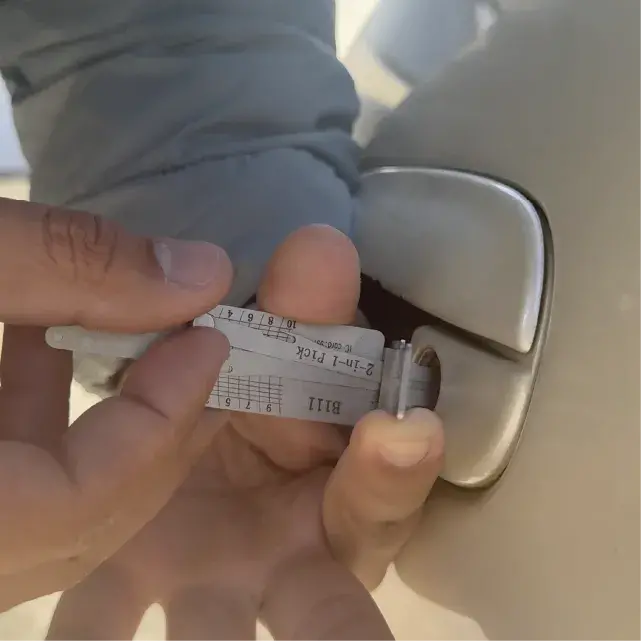
Lishi 2-in-1 decoder pick
Door lock actuator
How a car with the keys inside actually gets opened, step by step
This is the whole procedure. We publish it so you can watch the technician who shows up and tell whether they are doing it properly.
- 1
Identify the vehicle and the locking type
Make, model and year. Whether the key is a metal blade, a transponder key or a proximity key with push-button start. Whether the lock is a post, a lever, or purely an electric switch on the panel. That decides where entry is made and with what.
- 2
Verify who you are
Government photo ID plus questions only the owner can answer, recorded on the work order you sign. The technician who asks nothing is the warning sign, not the one who asks.
- 3
Protect the weatherstrip and the paint
The door edge is cleaned and the frame is protected before any tool goes in. This step is what separates an opening that leaves no trace from one that leaves scratched paint.
- 4
Open the gap with the plastic wedge, then the air wedge
The rigid wedge separates the top corner of the door. The inflatable bag goes into that gap and is inflated gradually. A little, not a lot: the door moves millimetres, not inches.
- 5
Go in with the long reach tool and open it from the inside
The rod goes through the gap and works the interior handle, the lock button or the unlock switch, depending on the vehicle. The lock cylinder is never forced: the door opens the way it always opens.
- 6
Deflate, inspect, close
The bag is deflated, everything comes out, and the weatherstrip and door are checked so the door closes and seals exactly as before. If the weatherstrip is left standing proud, the job is not finished.
Why the car locked itself with the key fob inside
A passive-entry car is not supposed to let itself be locked with the key inside. It looks for the fob using low-frequency antennas in the cabin and blocks the lock if it finds it. When it locks anyway, it is almost always one of four things.
One: the fob coin cell is weak. The car asks the fob a question and the fob answers faintly. The car reads that weak answer as a fob that is outside, and locks. This is the most common cause and the cheapest to fix. The cell is commonly a CR2032, but the exact type varies by model, so confirm it in the manual before buying one.
Two: the fob is sitting in a dead zone. In the trunk, on the floor under a seat, inside a metal lunchbox or a bag with a metallised lining. The interior antenna cannot reach it, so as far as the car is concerned the fob is not inside.
Three: something is blocking the signal. Metal around the fob, or another transmitter sitting on top of it.
Four: the door sensor never registered that the door opened, so the auto-relock ran with the fob still inside.
None of the four can be fixed from outside the car. But knowing which one it was keeps it from happening again, and if it was the coin cell we replace it on the same visit so you are not calling about the same thing next month.
If the problem is not that the key is inside but that the fob stopped responding altogether, that is a different fault with its own page: smart keys and key fobs. And if no key exists anywhere, the way out is cutting a new key, not an opening.
The keys are locked in and the engine is still running
Say that in your first sentence when you call, because it changes the order of the queue. If the car is running in a closed garage or an unventilated parking structure, that is no longer a door problem: carbon monoxide accumulates. Leave the enclosed space and call 911. If the car is outdoors the risk is a different one and it is financial: the engine keeps burning fuel with the climate control running, and if the tank was low it will stall before anyone arrives, turning a simple opening into an opening plus a dead battery.
The cars we actually open
Makes, models and year spans our technicians work on across Miami-Dade and Metro Atlanta. Not a luxury-brand list copied off a brochure: this is what gets opened in the street, plus the work vans.
| Model | Years | Key Type | What We Do |
|---|---|---|---|
| Toyota Corolla | 1999-2018 | Metal blade in the early years, transponder key in the later ones | Non-destructive entry. Key cutting and programming if it is also needed |
| Toyota Camry | 2008-2020 | Transponder key, or proximity key with push-button start on equipped trims | Non-destructive entry. Key cutting and programming if it is also needed |
| Toyota RAV4 | 2009-2016 | Transponder key, or proximity key with push-button start on equipped trims | Non-destructive entry. Key cutting and programming if it is also needed |
| Toyota 4Runner | 2001-2022 | Metal blade in the early years, transponder key in the later ones | Non-destructive entry. Key cutting and programming if it is also needed |
| Toyota Tacoma PreRunner | 2015 | Transponder key, or proximity key with push-button start on equipped trims | Non-destructive entry. Key cutting and programming if it is also needed |
| Honda Accord | 1998-2019 | Metal blade in the early years, transponder key in the later ones | Non-destructive entry. Key cutting and programming if it is also needed |
| Honda Civic | 2010-2022 | Transponder key, or proximity key with push-button start on equipped trims | Non-destructive entry. Key cutting and programming if it is also needed |
| Honda CR-V | 2003-2014 | Transponder key | Non-destructive entry. Key cutting and programming if it is also needed |
| Nissan Altima | 2014-2021 | Proximity key with push-button start | Non-destructive entry. Key cutting and programming if it is also needed |
| Nissan Sentra | 2010-2025 | Transponder key, or proximity key with push-button start on equipped trims | Non-destructive entry. Key cutting and programming if it is also needed |
| Nissan Rogue | 2011-2023 | Transponder key, or proximity key with push-button start on equipped trims | Non-destructive entry. Key cutting and programming if it is also needed |
| Hyundai Sonata | 2008-2017 | Transponder key, or proximity key with push-button start on equipped trims | Non-destructive entry. Key cutting and programming if it is also needed |
| Chevrolet Silverado | 2015-2023 | Transponder key, or proximity key with push-button start on equipped trims | Non-destructive entry. Key cutting and programming if it is also needed |
| Chevrolet Malibu | 1999-2017 | Metal blade in the early years, transponder key in the later ones | Non-destructive entry. Key cutting and programming if it is also needed |
| Chevrolet Cruze | 2014-2015 | Transponder key | Non-destructive entry. Key cutting and programming if it is also needed |
| Chevrolet Equinox | 2010 | Transponder key | Non-destructive entry. Key cutting and programming if it is also needed |
| Ford F-150 | 2012-2020 | Transponder key, or proximity key with push-button start on equipped trims | Non-destructive entry. Key cutting and programming if it is also needed |
| Ford Explorer | 2009-2020 | Transponder key, or proximity key with push-button start on equipped trims | Non-destructive entry. Key cutting and programming if it is also needed |
| Ford Fusion | 2007-2015 | Transponder key, or proximity key with push-button start on equipped trims | Non-destructive entry. Key cutting and programming if it is also needed |
| Ford Ranger | 2021-2023 | Proximity key with push-button start | Non-destructive entry. Key cutting and programming if it is also needed |
| Volkswagen Jetta | 2007-2020 | Transponder key, or proximity key with push-button start on equipped trims | Non-destructive entry. Key cutting and programming if it is also needed |
| Volkswagen Atlas | 2024-2025 | Proximity key with push-button start | Non-destructive entry. Key cutting and programming if it is also needed |
| RAM 2500 | 2012-2025 | Transponder key, or proximity key with push-button start on equipped trims | Non-destructive entry. Key cutting and programming if it is also needed |
| Mercedes-Benz C300 | 2010-2022 | Proximity key with push-button start | Non-destructive entry. Key cutting and programming if it is also needed |
| BMW 535i | 2010-2017 | Proximity key with push-button start | Non-destructive entry. Key cutting and programming if it is also needed |
| Lexus RX350 | 2013-2024 | Proximity key with push-button start | Non-destructive entry. Key cutting and programming if it is also needed |
| Land Rover Discovery | 2008-2025 | Proximity key with push-button start | Non-destructive entry. Key cutting and programming if it is also needed |
| Freightliner Sprinter 2500 | 2016 | Transponder key | Non-destructive entry. Key cutting and programming if it is also needed |
If your vehicle is not on the list, ask anyway. The list is what we see often, not the limit of what we can open.
What a legitimate locksmith asks for before opening your car
For a simple opening, when you are standing there looking at the keys inside: government photo ID plus questions only the owner can answer, recorded on the work order you sign. If a new key also has to be made because no key exists anywhere, the bar goes up: title, registration or an insurance card in the caller's name, plus photo ID that matches that name. That is not our paperwork. It is the only thing separating a locksmith from somebody who opens other people's cars, and the warning sign is the opposite of what people expect: worry about the one who asks for nothing.
What it costs to unlock a car with the keys inside
These are the three published lines that apply when the keys are locked in. The dispatcher confirms the exact total on the phone before a technician is sent.
| Service | Day Rate | Night / Weekend |
|---|---|---|
| Car lockoutNon-destructive entry. Final price depends on the vehicle | $100 - $250 | +$120 night |
| Trunk lockout | $100 - $250 | +$120 night |
| All-keys-lost programmingFull new system pairing. The spread is the make: a Toyota key and a Ferrari key are not the same job | $200 - $1,000 | Varies by vehicle |
*Prices shown are reference only. Final cost varies based on the complexity of the service, the specific hardware involved, the vehicle make, model and year, and the time of service. We provide an exact phone quote before our technician is dispatched. Automotive prices depend on the make, the model and the year of the vehicle. A key for a Toyota and a key for a Ferrari are not the same job, and the ranges above reflect that spread. The dispatcher confirms the exact total on the phone before a technician is sent.
FAQ - Keys Locked Inside the Car
The questions people actually ask on the phone when the keys are sitting inside the car, answered the way we answer them on the phone.
Every automotive job has its own page
The process, the published range and what the van brings, one page per job.
Lost Car Key Replacement
Mobile cut and OEM programming on-site
Car Key Programming
Transponder, smart key, proximity fob pairing
Smart Key & Key Fob
Push-to-start, proximity fobs, 2014+ vehicles
Ignition Repair
Cylinder replacement, Mercedes ESL, BMW EWS
Broken Key Extraction
Snapped key removal without drilling
Car Key Duplication
Spare keys, copies, transponder cloning
Trunk Lockout
Mobile trunk opening 15-30 min
ECU & Module Programming
ECU, BCM, PCM, TCM flashing and coding
Luxury Key Programming
Mercedes, BMW, Range Rover, Audi, Porsche, Bentley
¿Prefiere leerlo en español?Se me quedaron las llaves adentro del carro
La versión en español no es una traducción: está escrita aparte, con la ley de Florida, las herramientas y el precio explicados en español.
If you have already tried everything above, now make the call.
You hear the price before the van leaves, and you hear which ID the technician will ask for when it arrives.